
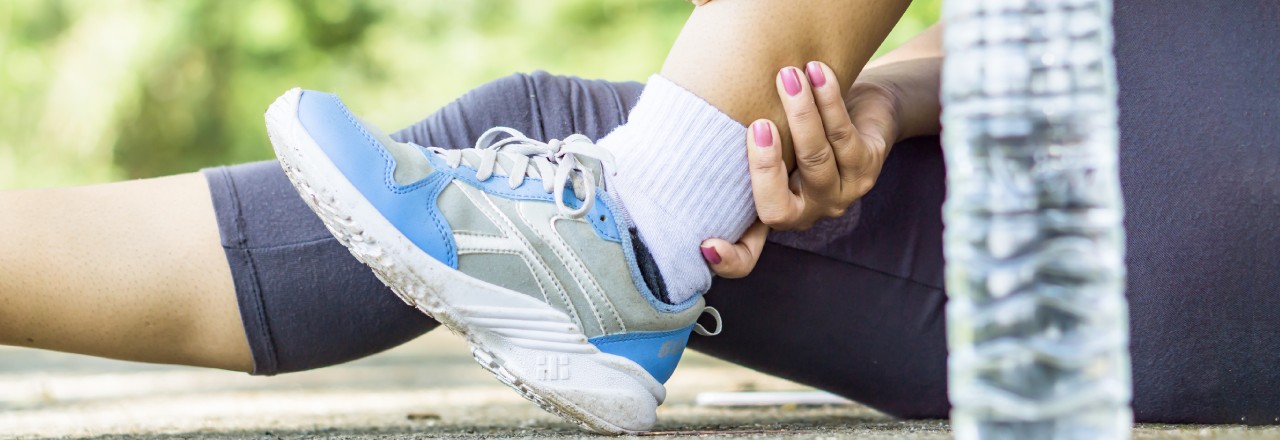
‘If I am not running in pain, I am not running enough am I?’
This is something I hear a lot with clients who believe that unless they are in pain, they aren’t doing enough.
Sounds right?
Wrong!
When we are in pain, we compensate to offload the issue (just watch someone walk for the first time having been on crutches after an operation for a while and you will see what I mean). Pain is a neurological response to injury and trauma, it is our brain telling our body to stop doing something. With this in mind, it makes sense that doing an exercise that stresses the body (like running) whilst in pain, is not a good idea. You wouldn’t put out an open fire with your hands over and over again would you?
Same principle!
There are two different kinds pain runners often experience, below we are going to explore how they differ and what needs to be done to get you back on your feet as soon as possible (pun intended).
Structural pain
This can be categorised clearly, if you have caused structural damage to a tissue, then you have structural pain. If you fall off the kerb and roll your ankle, your ankle swells and you start limping, it is very likely that you have caused structural damage to your body. This can be anything from micro-trauma to muscles or ligaments, to a rupture of said muscles or ligaments or even a dislocation of your ankle. If the damage is minor, then normally you can offload the body, follow simple RICE principles (rest, ice, compression, elevation) and be back on your feet in no time. If you don’t see improvement, then you need to see an osteopath to diagnose and treat the injury. A lot of structural injuries follow a typical treatment pattern and aren’t too complex, but it is never a bad idea to get checked out either way! Osteopathy combined with rehabilitation is the best way to speed up recovery and limit the chance of re-injury.
Mechanical pain
This is where it gets a little more complex. How many of you know runners, or have experienced yourself, something like this:
- My pain is random and doesn’t always happen
- I can run 10k, then my pain comes on straight away
- Sometimes my right knee hurts, then I run again and my left knee hurts in the same place
- Once I stop running, my pain stops, then I run again and my pain comes back
- I have had pain for a number of years and it doesn’t stop me running, but I am not getting faster
- I have had X-rays and MRI scans, they show no issues whatsoever
This is typical with the following injuries:
- ITB syndrome
- Runners knee
- Calf/Achillis tightness
- Low back pain
- Shin splints
- Plantarfascitus
If any of these sound familiar, then it is likely to be mechanical pain. The likelihood is, the way you are running is contributing to the problem. When we run, we can put anything from 3-5 times our bodyweight through each leg when we land, most of us have a cadence of between 160-180 steps per minute, therefore if you weight 50kg, with 3 times your bodyweight going through the ground at 160 steps per minute you have to absorb 12,000kg of force through each leg, every minute! It doesn’t take long for that to add up.
We are asymmetrical animals by nature, we have a dominant and a non-dominant side of the body. If your left side has to accept 2% more stress than the right, if you spend 2% more time on the ground on your left compared to the right, if you bounce 2% more on the left to the right, your left side is going to be taking a pounding compared to the right and an overload injury is likely. I see mechanical based pain on a nearly daily basis, athletes have been to their GP, seen a number of physiotherapists, seen a strength and conditioning coach, all of which helps, but the problem is still there. The only natural conclusion to make is that your running style is likely the cause of your mechanical pain. All of the above may help your symptoms, it may not fix the problem.
Running is a skill like any other, like playing an instrument, swinging a golf club or catching a ball, it can be taught! 65% of runners get injured every year, how many of those are avoidable by running efficiently to reduce the stress the body takes? Remember, practice doesn’t make perfect, it makes permanent! Do something enough and your body gets used to doing it and it turns into habit, whether or not this is good for your body or not. I can’t hit a golf ball in a straight line for love nor money, but if there was a competition for who can slice it off the fairway the furthest, sign me up.
The key to pain is to identify whether or not structural damage has been caused. If not, then it’s all about biomechanics, what part of your running technique is contributing to the pain. Once you know that, you are half way through addressing the issue, then it’s all about improving your technique, and that is where the fun begins!
I like to say that pain is made up. That doesn’t mean it doesn’t exist, just that it is coming from your brain. Pain is there for a reason, if it is slowing you down, or you are finally fed up with it, we can help!
